


Marketing project management is the process of planning, coordinating, and delivering marketing campaigns within agreed timelines and objectives. For agencies, it also means managing campaigns for several clients at once, coordinating different specialists, and keeping feedback and deliverables organized across multiple channels.
A campaign might involve a landing page, email sequence, paid social creatives, and organic content. Each deliverable has its own owner and deadline, but they all need to come together for the same launch.
This guide explains how agencies can manage that work, from the initial brief to campaign measurement, while keeping multiple client accounts moving.
In short
- Marketing project management gives agency teams a structured way to plan and deliver campaigns.
- A typical campaign moves through six phases: brief, plan, produce, review and approve, launch, and measure.
- Clear ownership matters because several specialists may contribute to the same campaign.
- Agencies managing multiple clients need a consistent structure for projects, recurring deliverables, feedback and campaign calendars.
- The right project management software should make work and responsibilities easier to see without adding unnecessary complexity.
What is marketing project management?
Marketing project management is the process of organizing people, tasks, timelines and resources to deliver marketing campaigns. It covers the work required to take a campaign from its initial brief through production, review, launch and measurement.
For an agency, the challenge is not just completing one campaign. Teams often manage several campaigns for different clients at the same time, each with its own objectives, deliverables, communication channels and deadlines.
How is marketing project management different at an agency?
In an in-house marketing team, most projects serve one organization and its internal priorities. An agency works across several client accounts, so the same team may be producing a product launch for one client, a webinar campaign for another, and a monthly content calendar for a third. That creates a few additional coordination requirements:
- Several client accounts: Work needs to stay organized by client so that briefs, tasks and deliverables don't get mixed up.
- Different campaign channels: One campaign may involve email, paid social, organic content, a landing page and other deliverables.
- Client feedback: Reviews and comments may arrive through email, Slack or shared files.
- Different deadlines: Campaign launch dates, content schedules and client review timelines need to be coordinated.
- Shared team capacity: Designers, writers and channel specialists may work across multiple accounts.
The process needs to give the team a clear view of both the individual campaign and the work happening across clients.
Why marketing agencies need project management
Marketing agencies need project management because campaign delivery involves several people, channels and deadlines that must stay coordinated.
Without a consistent system, teams can spend too much time chasing updates, checking conversations and working out which deliverable is ready for review.
Some common challenges include:
Feedback scattered across channels
A client might share landing page comments in an email, send creative feedback through Slack and add another change in a shared document. When feedback is spread across conversations, the team needs to work harder to understand what has changed and what still needs attention.
Multiple channels within one campaign
A campaign rarely involves just one deliverable. A webinar launch, for example, may need a landing page, email invitations, paid social creatives and organic posts. These pieces need to be coordinated around the same launch date.
Deadlines dependent on client sign-off
A designer may finish a creative on time, but the next step can depend on the client reviewing and approving it. If the review is delayed, the rest of the campaign schedule may also need to change.
Specialists working across several accounts
A designer might be working on three clients' campaigns in the same week. Without clear task ownership and priorities, it becomes difficult to understand what needs attention first.
A defined project management process helps agencies coordinate these moving parts without treating every campaign as a separate, disconnected workflow.
The marketing project management process: six phases
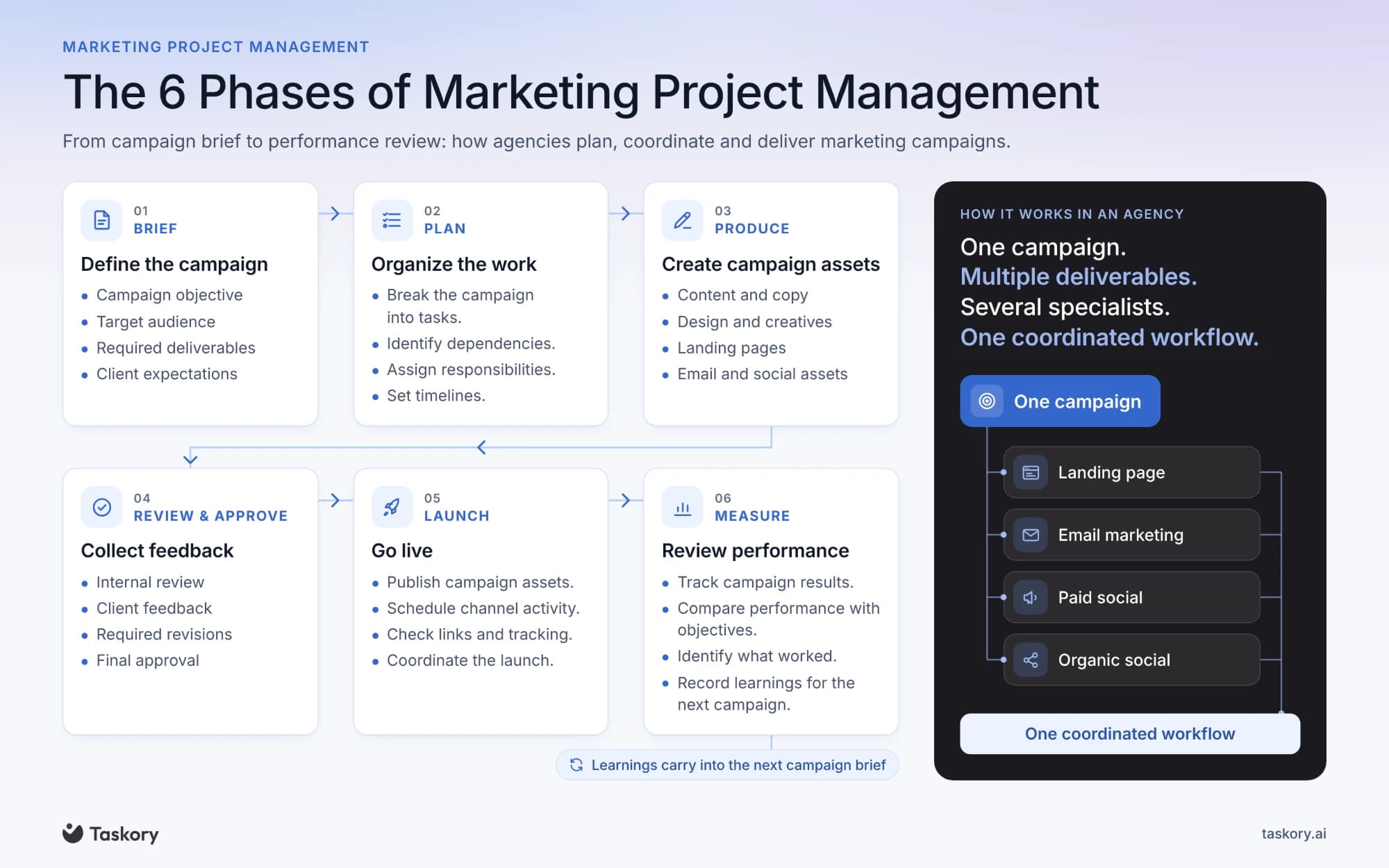
A marketing campaign typically moves through six phases: brief, plan, produce, review and approve, launch, and measure. Each phase has a clear purpose, although the people involved and the amount of work will vary by campaign.
1. Brief: Define what the campaign needs to achieve
Every campaign starts with a brief. It explains what the client wants to achieve, who the campaign is for, what needs to be delivered and when it needs to go live. For an agency, the brief should also make it clear who the client contact is and who will provide feedback or final approval. For example, a webinar campaign brief might include:
- Campaign objective and target audience
- Webinar topic and date
- Landing page requirements
- Email invitation and reminder requirements
- Paid and organic social deliverables
- Brand guidelines and reference materials
- Client review and launch dates
The brief gives the team a shared understanding of the work before production begins.
If you need a more structured way to capture incoming client requests, see our guide to the project intake process. For documenting agreed deliverables and responsibilities, use this SOW template for agencies.
2. Plan: Break the campaign into deliverables
Once the brief is clear, turn it into a campaign plan. Identify the deliverables, assign the people responsible for them, and establish the order in which the work needs to happen.
For example, a webinar campaign may require:
Deliverable
Landing page copy
Responsible team
Content
Dependency
Campaign brief
Deliverable
Landing page design
Responsible team
Design
Dependency
Approved copy
Deliverable
Email invitations
Responsible team
Email marketing
Dependency
Registration page
Deliverable
Paid social creatives
Responsible team
Design and paid media
Dependency
Campaign messaging
Deliverable
Organic social posts
Responsible team
Social media
Dependency
Campaign messaging
Deliverable
Campaign launch checks
Responsible team
Campaign lead
Dependency
Completed deliverables
| Deliverable | Responsible team | Dependency |
|---|---|---|
| Landing page copy | Content | Campaign brief |
| Landing page design | Design | Approved copy |
| Email invitations | Email marketing | Registration page |
| Paid social creatives | Design and paid media | Campaign messaging |
| Organic social posts | Social media | Campaign messaging |
| Campaign launch checks | Campaign lead | Completed deliverables |
Some tasks can happen at the same time. Others depend on earlier work being completed. The landing page, for instance, needs to be ready before the team can confidently use its final URL in promotional emails and social posts.
The plan should make these relationships clear so that the team knows what can move forward and what is waiting on another deliverable.
3. Produce: Coordinate the campaign work
The production phase is where the team creates the campaign assets and completes the planned deliverables. Depending on the campaign, this may involve writers, designers, developers, paid media specialists, SEO specialists, and social media managers. Each person should know:
- What they are responsible for producing
- Where the relevant brief and reference materials are stored
- Who they need to coordinate with
- When their work is expected to be ready
For campaigns with several deliverables, keep the work connected to the same campaign or project. This makes it easier to understand how individual tasks contribute to the overall launch.
4. Review and approve: Get the right feedback before launch
Before anything goes live, the relevant team members and client stakeholders need an opportunity to review the work. The agency should make it clear which version is ready for review, who needs to provide feedback and what needs to be changed. A practical review process includes:
- The responsible team member marks the deliverable ready for review.
- The account lead or campaign manager checks it before sending it to the client, where applicable.
- The client approver reviews the work and shares feedback.
- The team records the requested changes and confirms when the updated version is ready.
Keep review stages proportionate to the work. A small social post may need a simpler review than a major product launch.
Most importantly, make sure feedback is connected to the relevant deliverable. This reduces the chances of a comment being missed in a separate conversation.
5. Launch: Coordinate the campaign going live
The launch phase brings the completed deliverables together. Before launch, check that the required assets are ready, the relevant links work, the scheduled content is correct and the campaign team knows the launch sequence. A simple launch checklist might include:
- Landing page published and tested
- Email links and registration links checked
- Paid campaigns reviewed and scheduled
- Organic social posts prepared
- Final creative and copy approved
- Tracking and campaign measurement requirements checked
- Team members informed of the launch schedule
Not every campaign needs the same checklist. Build it around the channels and deliverables involved.
6. Measure: Review campaign performance
Once the campaign is live, review its performance against the original objective. The metrics will depend on what the campaign was designed to achieve. A lead-generation campaign might focus on registrations and qualified leads, while a content campaign may look at traffic, engagement and conversions. The campaign review should answer three questions:
- Did the campaign achieve its intended objective?
- Which channels and deliverables contributed to the result?
- What should the team change in the next campaign?
Record the findings so they can inform future planning. A useful project status report template can also help keep campaign progress and outcomes clear for stakeholders.
What does a marketing project manager do at an agency?
A marketing project manager coordinates the people, deliverables and timelines involved in a campaign. Their role is to keep the work organized, make responsibilities clear and help the team move from the brief to launch.
At an agency, the project manager also needs to coordinate work across client accounts. They may work closely with account leads, strategists and channel specialists to keep campaign activity moving.
The responsibilities are often shared across several roles:
Role
Account lead
Main responsibility
Manages the client relationship, gathers requirements and coordinates client communication.
Role
Marketing project manager
Main responsibility
Organizes the campaign plan, tracks deliverables and coordinates timelines and dependencies.
Role
Marketing strategist
Main responsibility
Defines the campaign direction, audience, messaging and channel approach.
Role
Content and creative team
Main responsibility
Produces copy, design assets, videos and other campaign materials.
Role
Channel specialists
Main responsibility
Manage execution across channels such as email, paid media, SEO and social media.
Role
Client approver
Main responsibility
Reviews deliverables, provides feedback and confirms approval before launch.
| Role | Main responsibility |
|---|---|
| Account lead | Manages the client relationship, gathers requirements and coordinates client communication. |
| Marketing project manager | Organizes the campaign plan, tracks deliverables and coordinates timelines and dependencies. |
| Marketing strategist | Defines the campaign direction, audience, messaging and channel approach. |
| Content and creative team | Produces copy, design assets, videos and other campaign materials. |
| Channel specialists | Manage execution across channels such as email, paid media, SEO and social media. |
| Client approver | Reviews deliverables, provides feedback and confirms approval before launch. |
In smaller agencies, one person may take on more than one of these responsibilities. The important thing is not the job title. It is making sure that every part of the campaign has a clear owner.
Marketing project management example: A multi-channel webinar campaign
Consider a marketing agency managing a webinar campaign for a B2B client. The webinar is scheduled for the end of the month, and the agency needs to coordinate a landing page, email invitations, paid social creatives and organic social posts.
Here's how the campaign moves through the six phases.
Brief
The client shares the webinar topic, target audience, date and campaign objective. The account lead confirms the required deliverables and collects the relevant brand and product information.
Plan
The project manager breaks the campaign into individual tasks. The content team handles the landing page and email copy, the designer creates the social creatives, and the channel specialists prepare the promotional activity.
The landing page is scheduled first because the email and social promotions will need its registration link.
Produce
The content team prepares the landing page and email copy. The designer works on paid and organic social assets. The project manager checks progress and follows up on tasks that depend on earlier deliverables.
Review and approve
The account lead shares the completed assets with the client approver. The client requests a change to the webinar headline and a revision to one of the social creatives.
The team records the feedback against the relevant deliverables and updates the work before requesting final approval.
Launch
Once the required assets are approved, the landing page goes live. The email invitations are scheduled, paid social activity is prepared, and organic posts are published according to the campaign schedule.
Measure
After the webinar, the team reviews registrations, attendance and campaign performance across the channels used. The findings are shared with the client and recorded for the next campaign.
The example shows why marketing project management needs to connect individual deliverables to one campaign objective. The landing page, emails and social posts are separate tasks, but they all contribute to the same launch.
How to manage marketing projects across multiple clients
Managing several clients requires more than a campaign plan for each account. Agencies also need a consistent way to organize client work, manage recurring deliverables and see what different team members are handling.
Here are four practical ways to do that.
1. Keep each client's work separate
Start with a clear structure for each client. Client information, projects, campaign tasks and relevant conversations should be organized so that the team can find the right context without searching through unrelated work.
This becomes especially important when team members work across several accounts.
The distinction between an account and a project matters here. An account represents the client relationship, while projects organize specific areas of work within that relationship. See our guide to account vs. project for a closer explanation.
2. Set up recurring monthly deliverables
Many agency responsibilities repeat every month. These may include content calendars, social posts, email campaigns, reporting and optimization tasks. Instead of rebuilding the same workflow every month, organize recurring work into a repeatable structure. This makes it easier for the team to understand what needs to happen during each cycle. For example, a monthly content cycle might include:
- Content planning
- Topic and keyword research
- Draft preparation
- Internal review
- Client review
- Publishing
- Performance review
Taskory supports recurring sprints for organizing monthly deliverables. You can read more about how recurring sprints work.
3. Keep campaign feedback connected to the work
When a client shares feedback through email or Slack, the team needs to connect that information to the relevant campaign and deliverable.
Otherwise, a designer might be working from an older instruction while the latest revision sits in a separate conversation.
Establish one place where the team can review the latest feedback and clarify what needs to change. Make sure the person responsible for the deliverable can access the relevant context.
4. Maintain visibility across client calendars
An agency-wide view of upcoming campaign deadlines helps managers understand what is happening across accounts. Even if each client has a separate project structure, the team should be able to review upcoming launches, important deadlines and work that needs attention. A shared calendar or consolidated planning view can help answer questions such as:
- Which campaigns are launching this week?
- Which deliverables are waiting for client feedback?
- Which team members have work across several accounts?
- Are two clients expecting major deliverables from the same specialist at the same time?
The aim is to make workload and deadlines easier to coordinate without mixing information between client accounts.
How Taskory helps agencies manage marketing projects
Taskory is designed around the way agencies organize client work. Teams can create a separate account for each client, with projects and sprints underneath. This gives agencies a way to keep client work organized while managing individual campaigns and recurring deliverables.
A few relevant capabilities include:
- Organize work by client: Create a separate account for each client and manage their projects and sprints underneath it.
- Generate tasks from briefs and SOWs: Upload a brief or SOW to Sources and generate tasks from the document. The generated tasks can then be reviewed in the inbox before the team uses them. You can learn more about how to extract tasks from an SOW.
- Manage incoming client feedback: Feedback from email, Slack and meeting notes can appear in the inbox of the person who received it. This gives the team a place to review incoming information and decide what needs to become a task.
- Route work by department: Department hashtags such as #design and #content can route work to the relevant team lead for allocation.
- Keep task conversations together: Teams can use chat on individual tasks, with Slack history available on the task to provide additional context.
- Give clients a way to review work: Taskory's designed client access flow provides a free seat for clients to view, comment on and review tasks.
Taskory helps agencies organize campaign work and incoming information. Your team still decides priorities, manages client relationships and confirms when deliverables are ready to move forward.
You can explore the Taskory Slack integration to learn more about connecting Slack with your workflow.
What to look for in marketing project management software
Marketing project management software should help your team organize campaigns, coordinate deliverables and manage work across clients. The right choice depends on how your agency operates, the channels you use and the level of visibility your team needs.
Before choosing a platform, consider these six criteria.
1. Client and project organization
Can you keep each client's work separate while still giving managers a way to understand activity across accounts?
Look for a structure that supports client accounts, individual projects and recurring work.
2. Task ownership and deadlines
Can every deliverable have a clearly assigned owner and due date?
The software should make it easy to see who is responsible for each task and what needs attention next.
3. Collaboration and feedback
Can team members discuss work and keep relevant feedback connected to the task?
This is particularly important for agencies where client comments and internal discussions may otherwise be spread across several channels.
4. Recurring work
Can you organize work that repeats every week or month?
Content calendars, social publishing, reporting and campaign maintenance are common examples of recurring agency responsibilities.
5. Integrations and information access
Does the platform work with the communication and file-sharing tools your team already uses?
Consider the tools your clients and team rely on before deciding which integrations are essential.
6. Ease of adoption
Will your team and clients be able to understand the workflow without extensive training?
A platform with many features is not automatically the best choice. The workflow should be practical for the people who will use it every day.
For a closer look at the available options, read our guide to agency project management software.
Marketing project management best practices
A defined process gives your team a starting point. These practices can help make it more consistent across campaigns and client accounts.
1. Start every campaign with a clear brief
Don't begin production based on scattered messages or assumptions. Make sure the campaign objective, deliverables, audience and deadlines are clear before assigning work.
A short but complete brief gives everyone the same starting point.
2. Assign one owner to each deliverable
Several people may contribute to a landing page, email campaign or creative asset. However, one person should be responsible for coordinating each deliverable.
This makes it easier to follow up, resolve questions and understand who is accountable for the next step.
3. Keep feedback attached to the relevant work
Avoid relying on team members to remember feedback shared in different conversations.
Connect client comments and requested changes to the deliverable they relate to. This helps the team work from the latest instructions.
4. Plan around dependencies, not just deadlines
A campaign may have several deliverables that depend on one another. For example, email promotions may need the final landing page URL before they can be scheduled.
Identify these dependencies while planning. A deadline alone doesn't tell the team what needs to be completed first.
5. Review campaign performance after launch
Don't treat publishing or launching as the end of the project.
Review the campaign against its original objective, record what worked and identify what should change next time. This gives your agency useful information for future campaign planning.
For a broader approach to managing agency work, see our guide to project management best practices for agencies.
Build your marketing project management process
Marketing project management becomes more manageable when your agency has a consistent way to organize client accounts, plan campaigns, assign deliverables and review progress.
You don't need to change everything at once. Start with one campaign and map its six phases: brief, plan, produce, review and approve, launch, and measure.
Then make sure every deliverable has an owner, a due date and a clear place for feedback. Once the process works for one client, apply the same structure to other accounts and recurring campaigns.
As your agency grows, review where coordination takes the most time. It may be scattered feedback, unclear ownership, recurring work or difficulty seeing deadlines across clients.
The right process, supported by a practical project management system, can help your team spend less time coordinating work and more time delivering campaigns.
If you're looking for a way to organize client accounts, projects, sprints and incoming work, explore Taskory.
FAQ
Frequently asked questions
Marketing project management is the process of planning, coordinating and delivering marketing campaigns. It involves organizing tasks, people, resources and deadlines so that campaign deliverables are completed and launched in line with the campaign objective.
A marketing project manager coordinates campaign activities, assigns responsibilities, tracks deliverables and manages timelines. At an agency, they also help coordinate work across multiple client accounts and keep communication between the team and stakeholders organized.
A typical marketing project moves through six phases. Brief: define the campaign objective, audience and deliverables. Plan: break the campaign into tasks and establish responsibilities and timelines. Produce: create the required campaign assets. Review and approve: collect feedback and confirm that deliverables are ready. Launch: publish or activate the campaign across the planned channels. Measure: review performance against the campaign objective.
Agencies can manage multiple clients by keeping each client's work organized separately, creating individual projects for campaigns, assigning clear task owners and using a consistent process for recurring deliverables. They should also maintain visibility across client deadlines and make sure feedback is connected to the relevant work.
Marketing management focuses on the broader marketing strategy, objectives, budgets and ongoing performance of marketing activities. Marketing project management focuses on organizing and delivering specific marketing projects or campaigns, including their tasks, responsibilities, timelines and deliverables.
Marketing project management software should support client and project organization, task ownership, deadlines, team collaboration, recurring work and relevant integrations. For agencies, it is also useful to have visibility across multiple client accounts without mixing their information.

Keep reading
Related



Create account
One live record for every client, shared with your team.
Free to start, no credit card.